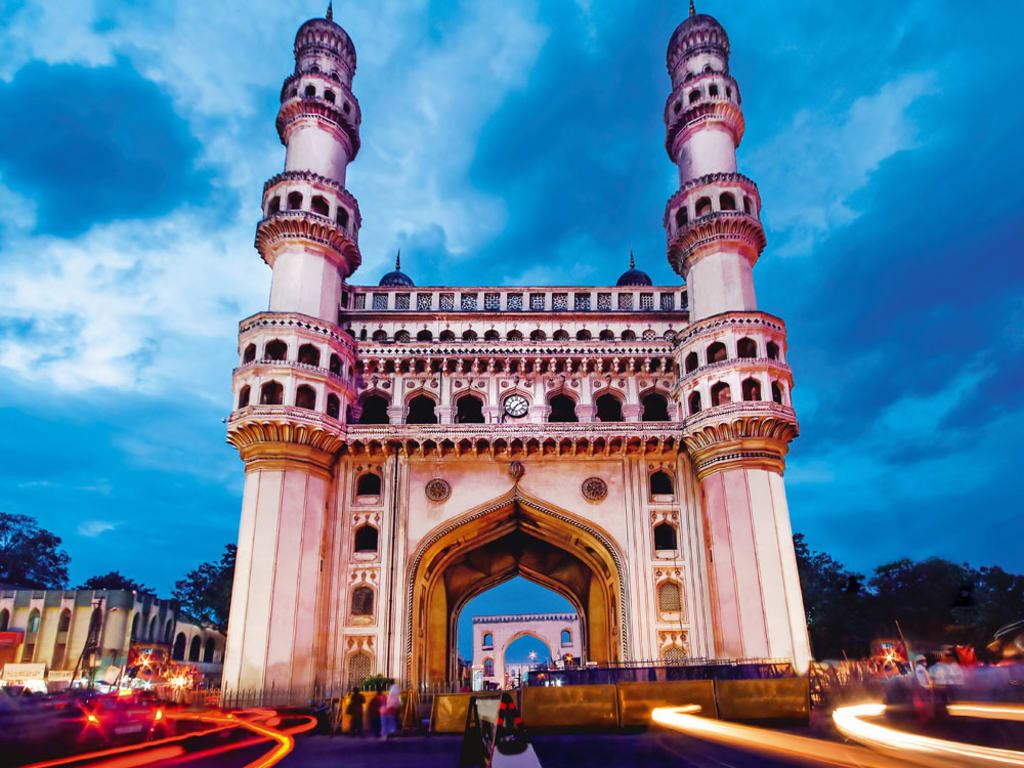
District Overview
Hyderabad district is located in the Indian state of Telangana. It encompasses the historic central region of Hyderabad city and is the smallest district in Telangana by geographical area. Hyderabad also serves as the state capital and is an important centre of administration, education, commerce, technology and culture.
The district occupies approximately 217 square kilometres and had a population of 39,43,323 according to the 2011 Census. It is entirely urban in its population classification and has one of the highest population densities among Indian districts.
Hyderabad is popularly known as the City of Pearls, reflecting its historic association with the trade in pearls and precious stones. The city is also recognised for its historic monuments, Deccani architecture, traditional markets, Urdu literature and distinctive food culture.
Important heritage landmarks include Charminar, Golconda Fort, Qutb Shahi Tombs, Mecca Masjid, Chowmahalla Palace, Paigah Tombs and Salar Jung Museum.
State: Telangana | Population: 39,43,323 (2011 Census) | Headquarters: Hyderabad | Urban district: 100%
Discover Hyderabad – A Historic Deccan Metropolis
Situated on the Deccan Plateau along the Musi River, Hyderabad developed into an important political and cultural centre under the Qutb Shahi rulers and later the Asaf Jahi Nizams. Founded in 1591 by Muhammad Quli Qutb Shah, the city grew around the historic Charminar and the surrounding Old City.
Its heritage includes monumental architecture, royal residences, mosques, tombs, temples, historic educational institutions and traditional bazaars. The city also developed a distinctive Deccani cultural identity through the interaction of Telugu, Urdu, Persian and other regional traditions.
Modern Hyderabad is an important centre for information technology, pharmaceuticals, biotechnology, education, healthcare, finance and research. The historic city and its contemporary urban districts together form a major metropolitan region.
Top Attractions in Hyderabad
Historic Monuments & Palaces

Charminar
Hyderabad's best-known historic landmark, built in 1591 by Muhammad Quli Qutb Shah. Its four minarets and grand arches form the centrepiece of the Old City.

Golconda Fort
A major fortified centre of the Deccan, developed under successive rulers and particularly associated with the Qutb Shahi dynasty.

Chowmahalla Palace
The historic palace complex associated with the Asaf Jahi Nizams, known for its courtyards, ceremonial spaces and Khilwat Mubarak.

Paigah Tombs
An important funerary complex associated with the powerful Paigah nobility of Hyderabad, noted for its intricate architectural ornamentation.

Qutb Shahi Tombs
A historic necropolis of the Qutb Shahi rulers, featuring domed mausoleums, arched structures and decorative architectural details.

Mecca Masjid
One of Hyderabad's major historic mosques, located close to Charminar and associated with the city's Qutb Shahi and later history.
Museums, Lakes & Cultural Places

Nizam Museum – Purani Haveli
A museum presenting objects, gifts and memorabilia associated with the Asaf Jahi rulers.

Hussain Sagar
A historic lake associated with the development of Hyderabad and Secunderabad, with the large Buddha statue on Gibraltar Rock.

Salar Jung Museum
A major museum on the southern bank of the Musi River, housing collections of art, sculpture, manuscripts, textiles, arms and decorative objects.
History of Hyderabad
Early Deccan History: The wider Telangana region experienced the rule of several major Deccan powers, including the Satavahanas, Chalukyas, Kakatiyas and Bahmani Sultanate. The history of the Hyderabad region is connected with these wider political and cultural developments.
Qutb Shahi Period: The Qutb Shahi dynasty emerged in the Deccan in the early 16th century. Golconda became an important political and commercial centre. In 1591, Sultan Muhammad Quli Qutb Shah founded Hyderabad and established Charminar as a central architectural landmark of the new city.
Mughal Conquest: In 1687, the Mughal emperor Aurangzeb conquered Golconda, bringing the Qutb Shahi kingdom to an end and incorporating the region into the Mughal Empire.
Asaf Jahi Period: In 1724, Nizam-ul-Mulk Asaf Jah I established the Asaf Jahi dynasty. Hyderabad developed as the capital of the princely state, with the Nizams exercising authority over a large territory in the Deccan.
British Period: Hyderabad State maintained a distinctive relationship with British India through the subsidiary alliance system. The Nizams retained internal authority while British political and military influence remained significant.
Integration into India: In September 1948, the Indian military operation known as Operation Polo ended the rule of the Nizam and brought Hyderabad State under the administration of the Indian Union.
Formation of Andhra Pradesh: On 1 November 1956, the Telangana region of Hyderabad State was merged with Andhra State to form Andhra Pradesh. Hyderabad became the state capital.
Formation of Telangana: On 2 June 2014, Telangana became India's 29th state, with Hyderabad as its capital. The city continued as the capital of Telangana and was also designated as the common capital of Andhra Pradesh for a transitional period under the Andhra Pradesh Reorganisation Act.
Dynasties & Historical Kingdoms
Hyderabad's political history is connected with the successive Deccan kingdoms and dynasties that shaped the region's architecture, administration, trade and cultural life.

Bahmani Kingdom
The Bahmani Sultanate, an important medieval Deccan power whose political fragmentation contributed to the emergence of the Deccan Sultanates.

Qutb Shahi Dynasty
The Golconda rulers who established Hyderabad in 1591 and left a major architectural and cultural legacy in the Deccan.

Asaf Jahi Dynasty – The Nizams
The ruling dynasty of Hyderabad State from 1724 until the integration of the princely state in 1948.
People, Literature & Intellectual Heritage
Hyderabad has a long literary and intellectual tradition shaped by Telugu, Urdu, Persian and other languages. The city became an important centre of Urdu literature, journalism, education, progressive writing and political activity during the 20th century.

Makhdoom Mohiuddin
Urdu poet, progressive literary figure and communist activist whose poetry became associated with the Telangana peasant struggle.

Mohib Hussain (1851–1930)
Urdu journalist, editor, poet and social reformer of Hyderabad. Born in Etawah and based in the Deccan from the 1870s, he edited Muallim-e-Shafiq, Muallim and Muallim-e-Niswan (1894–1901), one of India's earliest Urdu women's magazines, through which he advocated women's education and criticised restrictive purdah. Fined by the Hyderabad government and forced to close his magazine in 1901, he continued writing poetry and Sufi works — including Deewan-e-Muhib (1903) and Afkar-e-Muhibb (1926) — despite losing his eyesight in 1916.

Shoeb-ulla-Khan (c. 1919–1948)
Nationalist Urdu journalist and editor of Imroze during the final, violent years of Hyderabad State. After his first paper Rayyat was banned by the Nizam's government, he used Imroze to advocate Hyderabad's integration with India and to oppose the Razakar movement under Kasim Razvi. On the night of 21–22 August 1948 he was attacked in Chappal Bazaar, Kachiguda — his right hand severed and his body shot — dying within hours. Kasim Razvi was the principal accused but was later acquitted by the High Court. His murder, weeks before Operation Polo, became an enduring symbol of the dangers faced by dissenting journalists in Hyderabad.
Makhdoom Mohiuddin (1908–1969) became one of the prominent voices of progressive Urdu literature. His work combined romantic poetry with themes of social justice, workers' rights and political change. He was also associated with the Telangana Armed Struggle and progressive literary organisations in Hyderabad.
Other important dimensions of Hyderabad's intellectual history include Osmania University, the development of Urdu and Telugu publishing, Deccani literary traditions and the city's educational institutions.
Culture & Festivals
Deccani Culture: Hyderabad's cultural identity developed through interactions among Telugu, Urdu, Persian, Marathi and other linguistic and cultural traditions. Deccani Urdu, local music, poetry, cuisine and architectural traditions form important parts of this heritage.
Bonalu: A major Telangana festival dedicated to Goddess Mahakali. Celebrations are held at several temples and neighbourhoods across Hyderabad and Secunderabad during the Ashada month.
Bathukamma: The Telangana floral festival celebrated by women through flower arrangements, songs and community gatherings during the Navaratri season.
Ramzan: The month of Ramadan brings distinctive evening activity to the Old City. Markets around Charminar and other historic neighbourhoods become particularly active, with traditional foods and shopping.
Ganesh Chaturthi: Public and household celebrations take place throughout Hyderabad, with processions and immersion ceremonies forming part of the city's festival calendar.
Muharram: Hyderabad has longstanding Shia and other Muslim devotional traditions associated with Muharram, including gatherings and observances at historic religious locations.
Deccani Music and Poetry: Urdu mushairas, ghazals, Qawwali and regional performance traditions contribute to the city's cultural landscape.
Hyderabadi Cuisine & Food Heritage
Hyderabadi cuisine is one of the city's most recognised cultural traditions. It reflects a combination of Deccani, Persian, Mughlai and local culinary influences developed over several centuries.

Hyderabadi Haleem
A slow-cooked preparation traditionally made with meat, wheat, lentils, ghee and spices, particularly associated with Ramzan.

Hyderabadi Dum Biryani
A layered rice and meat dish of the Qutb Shahi and Asaf Jahi kitchens, prepared with raw marinated meat, basmati rice, saffron and kewra, slow-cooked in a sealed handi.
Hyderabadi Biryani: A celebrated rice preparation associated with the city's culinary identity, traditionally prepared with aromatic spices, rice and meat.
Haleem: A slow-cooked dish associated with Ramzan and registered as a Geographical Indication product. Hyderabad Haleem has GI Application No. 193.
Irani Chai: A popular tea tradition associated with Hyderabad's historic cafes and social life.
Osmania Biscuits: A well-known bakery product traditionally served with Irani chai.
Other Food Traditions: Double ka meetha, qubani ka meetha, marag, kebabs, pathar ka gosht and traditional sweets are also associated with Hyderabad's cuisine.
Traditional Crafts & Shopping
Hyderabad has long been associated with specialised crafts, jewellery, traditional markets and decorative arts. The Old City continues to preserve several historic commercial streets and artisan traditions.

Hyderabad Lac Bangles
Traditional handcrafted bangles made using natural lac resin and decorated with glass pieces, stones, beads and other embellishments.

Laad Bazaar
The historic market around Charminar, associated with bangles, bridal shopping, traditional accessories and jewellery.
GI Registration: Hyderabad Lac Bangles received Geographical Indication registration on 1 March 2024 under Application No. 917. Hyderabad Haleem is another GI-registered product associated with the city.
Pearl Trade: Hyderabad has a longstanding association with pearl jewellery and the trade in precious stones, contributing to its popular name, the City of Pearls.
Bidriware: Bidriware is a traditional metal-inlay craft associated primarily with Bidar in Karnataka and the wider Deccan cultural region. It is also sold in Hyderabad's markets.
Traditional Markets: Laad Bazaar, Pathergatti, Begum Bazaar, Sultan Bazaar and other historic shopping areas reflect the city's commercial heritage.
Travel Guide
How to Reach
By Air: Rajiv Gandhi International Airport at Shamshabad serves Hyderabad and the surrounding metropolitan region. Airport connectivity to the city is available through road transport and airport bus services.
By Rail: Hyderabad is served by major railway stations including Secunderabad Junction, Hyderabad Deccan (Nampally) and Kacheguda. The appropriate station depends on the destination and train service.
By Metro: Hyderabad Metro Rail connects several major urban areas. Metro stations provide access to commercial, residential and transport hubs, with onward travel required for some Old City attractions.
By Road: Hyderabad is connected with other Telangana districts and neighbouring states through national highways, state highways and the Outer Ring Road. TSRTC and private bus services connect the city with major destinations.
Best Time to Visit
October to February is generally more comfortable for sightseeing and outdoor visits. Summers can be very hot, while monsoon conditions may bring heavy rainfall and local traffic disruptions.
Travel Tips
- Allow additional travel time for the Old City, particularly during weekends and festivals.
- Use public transport or authorised parking areas around Charminar and other busy markets.
- Check monument and museum opening days before planning visits.
- Respect photography restrictions at religious sites and historic buildings.
- Carry drinking water during outdoor sightseeing.
- Confirm current entry fees and visiting arrangements with the relevant authorities.
- During Ramzan, expect increased evening activity and traffic around the Old City.
Where to Stay
- Abids and Nampally: Central areas with access to railway stations, shopping streets and historic locations.
- Secunderabad: A major railway and commercial centre with accommodation options.
- Banjara Hills: Hotels, restaurants and commercial establishments.
- HITEC City and Gachibowli: Accommodation suited to visitors travelling for business and technology-related activities.
- Old City: Convenient for visitors interested in Charminar, Laad Bazaar and nearby heritage sites.
Suggested Hyderabad Itineraries
One-Day Heritage Itinerary
- Morning: Begin with Charminar, Mecca Masjid and the surrounding Old City streets.
- Late Morning: Explore Laad Bazaar and the traditional markets around Charminar.
- Afternoon: Visit Chowmahalla Palace and Salar Jung Museum, subject to their opening days and available time.
- Evening: Visit Hussain Sagar and the surrounding waterfront attractions.
Two-Day Heritage Itinerary
- Day 1: Charminar, Mecca Masjid, Laad Bazaar, Chowmahalla Palace, Purani Haveli and Salar Jung Museum.
- Day 2: Golconda Fort, Qutb Shahi Tombs, Toli Masjid and Paigah Tombs, subject to travel time and opening arrangements.
History & Culture Itinerary
- Explore the Qutb Shahi architectural legacy at Charminar and Golconda.
- Visit the royal heritage associated with the Nizams at Chowmahalla Palace.
- Explore the Paigah Tombs and other historic monuments.
- Visit traditional markets and sample Hyderabadi cuisine.
These are suggested sightseeing sequences rather than fixed guided tours. Distances, traffic, entry arrangements and monument schedules should be checked before travel.
Mandals of Hyderabad District
Hyderabad district is administratively organised into 2 revenue divisions and 16 revenue mandals. The divisions are Hyderabad and Secunderabad.
Hyderabad Revenue Division – 8 Mandals
Secunderabad Revenue Division – 8 Mandals
Administrative names and spellings follow the district administration's revenue-division listing. Verify the latest mandal-level notification before making changes to this list.
Administration
District Headquarters: Hyderabad.
Revenue Divisions: 2 – Hyderabad and Secunderabad.
Revenue Mandals: 16.
District Administration: The District Collector and District Magistrate heads the district administration. Revenue divisions are administered through Revenue Divisional Officers, while mandals are administered by Tahsildars.
Municipal Administration: The district forms part of Hyderabad's wider urban governance framework. Municipal and metropolitan administrative boundaries should not be treated as identical to the revenue district boundary.
Vehicle Registration: Hyderabad has multiple transport registration offices. Registration series vary by office and current Transport Department allocations; a single district-wide code should not be assumed.
Important Areas & Neighbourhoods
Charminar: Historic centre of the Old City and the location of the iconic monument.
Pathergatti: Historic commercial street associated with traditional shopping and architecture.
Abids: Established commercial and shopping district in central Hyderabad.
Nampally: Important transport, commercial and administrative area.
Begum Bazaar: Traditional wholesale and retail trading area.
Purani Haveli: Historic palace area associated with the Nizams and the Nizam Museum.
Khairatabad: An established urban locality and administrative area.
Musheerabad: An important central Hyderabad neighbourhood with commercial and residential activity.
Himayatnagar: Established residential and commercial locality in central Hyderabad.
Secunderabad: A historic urban centre adjoining Hyderabad, with its own important railway, commercial and institutional heritage. Its name is also used for a revenue division of Hyderabad district.
Economy & Industries
Hyderabad is one of India's important urban economic centres. Its economy includes information technology, pharmaceuticals, biotechnology, healthcare, education, financial services, retail, hospitality, manufacturing and government administration.
Information Technology
Hyderabad's wider metropolitan region has become a major IT and technology destination. HITEC City, Madhapur, Gachibowli and the Financial District are among the important technology and commercial locations in the metropolitan area. Some of these areas fall outside Hyderabad revenue district.
Pharmaceuticals & Biotechnology
The Hyderabad region has an established pharmaceutical, biotechnology and life-sciences sector, supported by research institutions, universities, manufacturing facilities and healthcare organisations.
Trade & Commerce
Historic markets such as Begum Bazaar, Laad Bazaar and Pathergatti continue to support retail, wholesale trade, jewellery, traditional crafts and commercial activity.
Education & Healthcare
Hyderabad is an important centre for higher education, research, medical services and specialist healthcare institutions.
Tourism & Hospitality
Heritage tourism, museums, traditional markets, cuisine, hotels and cultural events contribute to the city's service economy.
Geography & Natural Features
Location: Hyderabad is situated in the Deccan Plateau in south-central India, within the state of Telangana.
Area: The official district geographical area is approximately 217 square kilometres.
River: The Musi River flows through Hyderabad and is a tributary of the Krishna River.
Terrain: The region is characterised by Deccan granite formations, rocky outcrops, undulating ground and urban development.
Hussain Sagar: The historic lake lies between Hyderabad and Secunderabad and is an important feature of the wider urban landscape.
Climate: Hyderabad experiences a tropical wet and dry climate, with hot summers, a southwest monsoon season and comparatively mild winters.
Rainfall: Most annual rainfall occurs during the southwest monsoon, generally from June to September.
The geographical and demographic statistics in this section refer to Hyderabad revenue district and should not be confused with Greater Hyderabad or the entire metropolitan region.
Frequently Asked Questions
What is Hyderabad famous for?
Hyderabad is known for Charminar, Golconda Fort, the Qutb Shahi and Asaf Jahi heritage, pearl trade, Hyderabadi biryani, haleem, lac bangles, Urdu literature and its modern technology sector.
Why is Hyderabad called the City of Pearls?
The name reflects the city's historic association with pearl trading and jewellery markets. Hyderabad developed as an important centre for the trade in pearls and precious stones.
When was Hyderabad founded?
Hyderabad was founded in 1591 by Muhammad Quli Qutb Shah, the fifth ruler of the Qutb Shahi dynasty. Charminar was established as a central landmark of the city.
How many mandals are there in Hyderabad district?
Hyderabad district has 16 revenue mandals organised under 2 revenue divisions: Hyderabad and Secunderabad.
What is the population of Hyderabad district?
The 2011 Census recorded a population of 39,43,323 in Hyderabad district.
What is the area of Hyderabad district?
The official district geographical area is approximately 217 square kilometres.
What is the literacy rate of Hyderabad district?
The 2011 Census-based district statistics report a literacy rate of 83.25%.
Who founded Hyderabad?
Muhammad Quli Qutb Shah founded Hyderabad in 1591 during the Qutb Shahi period.
Who were the Nizams of Hyderabad?
The Nizams were the rulers of the Asaf Jahi dynasty, which established its rule in Hyderabad in 1724 and continued until the integration of Hyderabad State into India in 1948.
What is Hyderabad's famous traditional craft?
Hyderabad is particularly associated with lacquer bangles sold around Laad Bazaar near Charminar. Hyderabad Lac Bangles received GI registration in March 2024.
Explore Hyderabad
Discover more articles on Hyderabad's history, heritage, people, cuisine, crafts and cultural traditions.
Hyderabad – Heritage, Culture & Modern Development
Hyderabad represents an important chapter in the history of the Deccan. Founded under the Qutb Shahi rulers, developed as the capital of the Asaf Jahi Nizams and later emerging as the capital of Telangana, the city has experienced several centuries of political, cultural and economic change.
Its heritage includes Charminar, Golconda Fort, Qutb Shahi Tombs, Paigah Tombs, Chowmahalla Palace, Mecca Masjid and historic commercial neighbourhoods. The city's literary, culinary and handicraft traditions continue to contribute to its cultural identity.
Alongside its historic character, Hyderabad has developed into a major centre for information technology, pharmaceuticals, healthcare, education, research and commerce.
- State: Telangana
- Headquarters: Hyderabad
- Revenue Divisions: Hyderabad and Secunderabad
- Revenue Mandals: 16
- Area: 217 km²
- Population: 39,43,323 (2011 Census)
- Literacy Rate: 83.25% (2011 Census)
- Historical Foundation: Hyderabad founded in 1591 by Muhammad Quli Qutb Shah
- Major Dynasties: Qutb Shahi and Asaf Jahi
- Major Monuments: Charminar, Golconda Fort, Qutb Shahi Tombs and Chowmahalla Palace
- Traditional Crafts: Hyderabad Lac Bangles and pearl jewellery
- GI Products: Hyderabad Haleem and Hyderabad Lac Bangles
- River: Musi
- Modern Economy: IT, pharmaceuticals, biotechnology, education, healthcare and commerce
Explore Telangana
Discover the districts, waterfalls, temples, forts, archaeological sites and cultural heritage of Telangana.
References
- Government of Telangana – Hyderabad District: About District, History, Demography, Administrative Setup, Revenue Divisions and Mandals.
- Directorate of Economics and Statistics, Telangana: Hyderabad District at a Glance and 2011 Census-based demographic statistics.
- Census of India 2011: Population, literacy, sex ratio and demographic information.
- Government of Telangana – Telangana Tourism: Heritage sites, monuments, museums and Hyderabad tourism information.
- Sahitya Akademi: Award information for Makhdoom Mohiuddin and Urdu literature.
- Geographical Indications Registry, Government of India: Hyderabad Lac Bangles, Application No. 917.
- Geographical Indications Registry, Government of India: Hyderabad Haleem, Application No. 193.
Population and demographic figures refer to the 2011 Census. Administrative figures are based on district government information. Historical traditions and popular origin stories should be distinguished from documented historical evidence. The Hyderabad revenue district is not synonymous with Greater Hyderabad or the full Hyderabad metropolitan region. Visitor information, monument schedules and fees may change.
Comments
Post a Comment